Sheffield cutlery makers serving London and the world for over 100 years0114 272 4969

Know what you have

Silver cutlery pattern identification service

A useful identification does more than attach a name to a pattern. It should tell you which features define the service, what size of knife is missing and whether a replacement can be sourced, adapted or made. Our assessment is grounded in manufacturing detail.

Decorative silver cutlery details examined for identificationMade at 33 Snow Lane, Sheffield

Good to knowStart with photographs; we ask for a physical piece only where handling or exact measurement is necessary.

Maker-led replacement work

How we approach your commission

Every project starts with the surviving object and the reason for replacing it. That keeps the work accurate, proportionate and useful.

The clues we look for

We study outline, terminal, border, relief, heel and the transition into the working end. On knives, blade and bolster may suggest a date range or specialist manufacturer even when decoration appears in several catalogues.

Marks are recorded separately and read in context. A retailer’s stamp, assay mark, maker’s initials and later repair marks can tell different parts of the story.
Identification for a practical purpose

Most clients contact us because something is missing. We connect identification to the next decision: continue searching for an original, accept a related period piece, repair a survivor or commission a new knife.

Where a name is uncertain, we can still document measurable features for a manufacturing assessment. An uncertain catalogue label need not hold up a viable project.

Built on Sheffield making knowledge

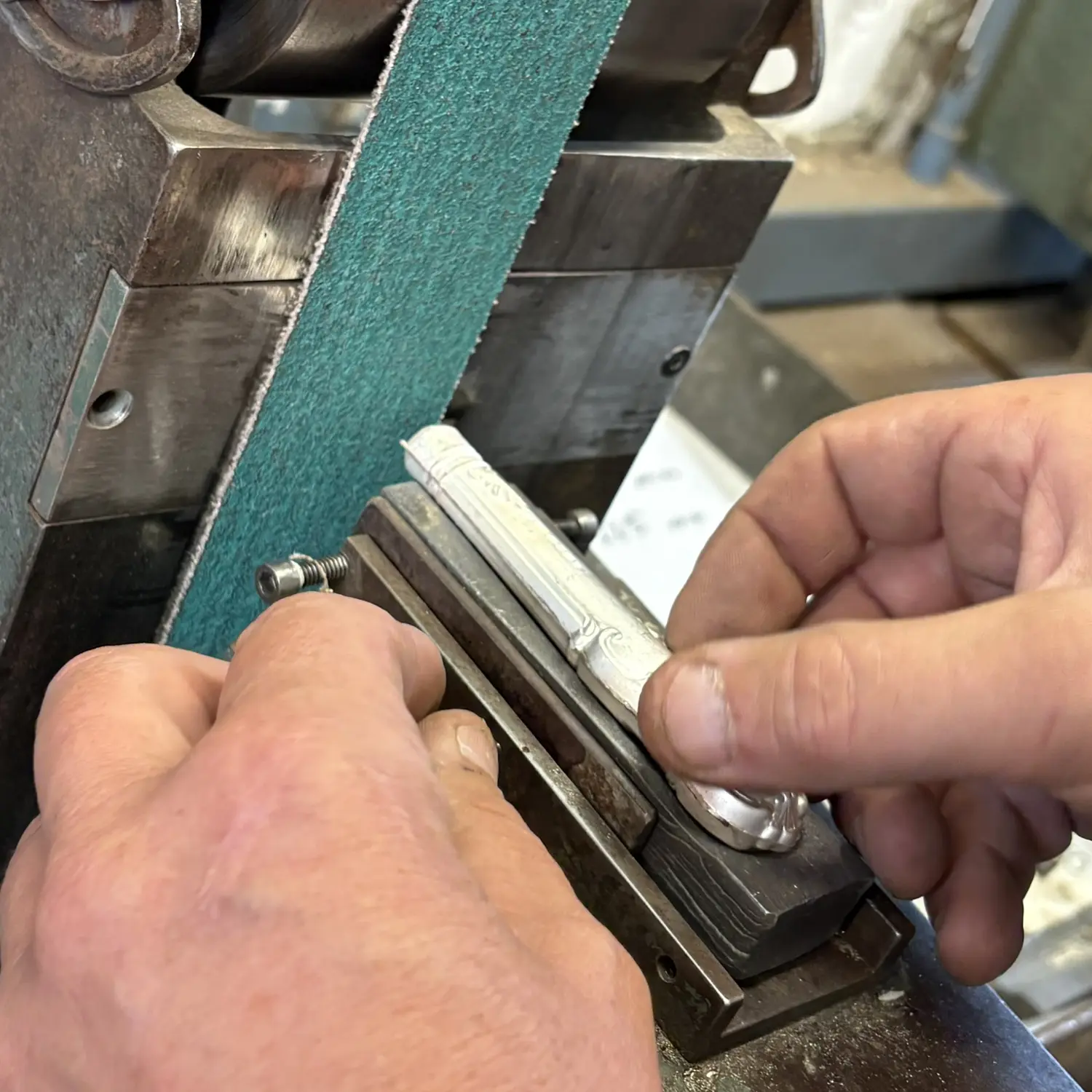
Handling tools, blanks and finished cutlery gives makers a different perspective from image-only comparison. Construction can reveal how a pattern was achieved and whether it can be repeated.

Our factory at 33 Snow Lane has supplied Sheffield, London and international customers for more than 100 years. That continuity informs identification and replacement work.

First assessment

What to send us

These details help us understand the pattern before any valuable original is transported.

  1. 01A full-length image of each distinct piece type
  2. 02Sharp photographs of every mark and symbol
  3. 03Measurements in millimetres and an image showing scale
  4. 04Box, retailer, family or acquisition history
Replacement silver knife being made in the Beatson Sheffield factory

From reference to replacement

Made by us in Sheffield

01

Identify

We review pattern, marks, construction and missing piece.

02

Specify

Dimensions, material, blade, quantity and finish are agreed.

03

Make

The replacements are formed, fitted and finished at our factory.

04

Compare

Finished work is checked against the approved reference.

Common questions

About pattern identification

Can you value my silver cutlery?

Our focus is identification for matching and replacement. Use a qualified silver valuer for formal market or insurance valuations.

Can you identify silver plate too?

We review a wide range of constructions, although the replacement route depends on material and pattern.

What photographs work best?

Use soft daylight, a plain background and square-on views. Include both sides, the profile, marks and a ruler.

Start with photographs

Could your silver service be complete again?

Email photographs or arrange a visit to our Snow Lane factory. We will explain what can be matched, made or restored.

Request an assessmentCall 0114 272 4969